You know the arc of a bad coffee day, even if you've never mapped it out loud. 8:14am: euphoric, invincible, texting people you don't need to text. 9:40am: fine. 11:15am: a low hum of unease you can't locate. 11:50am: irritable, cold-handed, googling your own symptoms. 12:30pm: second cup, because the only cure for a caffeine crash is more caffeine, and the cycle resets itself like a small, caffeinated tide.
Somewhere in the last few years, a cup started showing up in wellness aisles that promised to break that cycle — not by removing the coffee, but by cutting it in half and marrying it to something stranger. Ground mushrooms. Not on top. Blended in, brewed together, poured from the same bag.
It sounds, reasonably, like a trend. Part of it is. But underneath the trend is a genuinely interesting piece of biology, a fungus that may do something to your brain cells that sounds almost too dramatic to be true — and, as any good story should have, an honest twist near the end that most of the brands selling this drink would rather you didn't read.
Mushroom coffee is roughly half the caffeine of regular coffee, blended with adaptogenic mushrooms studied for their effect on stress hormones. The mushroom research is real and promising. The research on the actual brewed coffee blend, according to Harvard Health, is essentially nonexistent. Both things are true at once.
What's Actually in the Cup
Despite the name, it doesn't taste like a forest floor. Mushroom coffee is typically ground coffee beans blended roughly evenly with powdered medicinal mushrooms — usually some combination of Lion's Mane, Chaga, Cordyceps, and Reishi — brewed exactly like a normal cup. What changes is the dose of everything.
Less caffeine explains part of why people report a gentler ride. But it isn't the whole story, and the more interesting half of the story is what the mushrooms are actually doing while the caffeine does its usual thing.
The Thermostat, Not the Light Switch
The word doing most of the marketing heavy lifting here is adaptogen, and it's worth understanding properly, because it gets thrown around loosely enough to mean almost nothing. It doesn't mean "calming." It doesn't mean "energizing." It means something more specific and, honestly, more interesting than either.
Adaptogens are compounds — mostly from plants and fungi — studied for their ability to help the body resist and recover from stress, rather than push it in one direction. Research associated with scientist Alexander Panossian has focused on how they interact with the hypothalamic-pituitary-adrenal axis, the system that governs your cortisol output, and suggests they may help normalize cortisol whether it's running too high or too low — rather than simply suppressing it, the way a sedative would.
A stimulant is a light switch. It's on or it's off. An adaptogen, if the research holds, is closer to a thermostat — it doesn't fight the temperature of the room, it just tries to bring it back to normal.
That distinction is the entire premise of mushroom coffee. Less caffeine to spike you, plus a mechanism that — at least in theory, and at least for the mushrooms studied on their own — nudges your stress response back toward baseline instead of away from it.
The Fungus That Might Regrow Your Wiring
Here's the part that made me sit up the first time I actually read the research instead of the marketing copy.
Lion's Mane — the shaggy, almost coral-like mushroom in most of these blends — contains compounds called hericenones and erinacines. In laboratory studies, these compounds have been shown to stimulate the production of nerve growth factor, a protein your body uses to build and maintain the nerve cells that carry every thought you have.
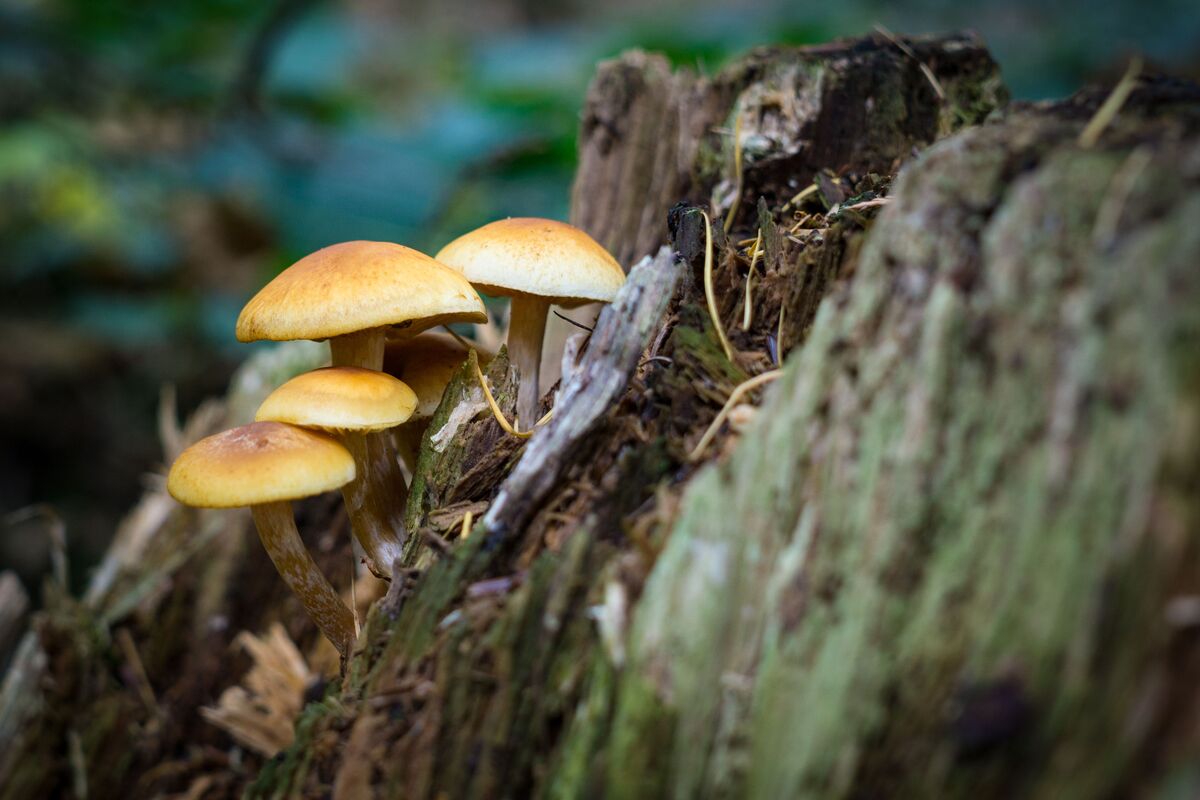
A mushroom, growing quietly on a dying log, producing a compound that — at least in a petri dish — tells your brain cells to keep building themselves. That is not a sentence I expected to write about a coffee additive.
The honest caveat belongs right next to the wow: this evidence comes overwhelmingly from cell cultures and animal studies. Human trials on Lion's Mane and cognition exist, but they're small, short, and mixed — some show real improvement in memory and focus measures, others show very little. The mechanism is real and remarkable. The proof that it reliably sharpens a human mind, at the dose in your morning cup, isn't settled yet. Both of those sentences belong in the same paragraph, and I'd be doing you a disservice to only give you one of them.
Lion's Mane isn't traveling alone in most blends. Each mushroom is chosen for a different, specific job:
The one behind the nerve growth factor research above. Most associated with cognitive clarity, though — as above — the human evidence is still developing rather than settled.
Traditionally used to support stamina and oxygen use during exertion. It's the closest thing in this blend to a genuine energy mushroom, working alongside the caffeine rather than instead of it.
Dense in antioxidant compounds and traditionally used to support the immune system. Less flashy than Lion's Mane, doing quieter background work.
Historically called the "mushroom of immortality" — the calming, sleep-adjacent one, and also the one that carries the most important safety caveats, more on that shortly.

The Honest Twist Nobody Selling This Wants You to Know
So far, this has been a fairly compelling case. Here's the part that turns it from a marketing story into an honest one.
Harvard Health Publishing, reviewing the state of the evidence, made a distinction that I think is the single most important sentence in this entire topic: medicinal mushrooms have real, growing scientific interest behind them individually — but there is very little human research on them overall, and none conducted specifically on mushroom coffee as a finished, brewed, blended product.
That's not a small asterisk. It means nobody has actually tested whether the compounds that impressed researchers in a lab survive being dried into powder, shipped, stored, and brewed in hot water at the concentration that ends up in your actual mug. The mushroom research is real. The extrapolation from "mushroom, studied on its own, in a lab" to "mushroom, blended into your Tuesday coffee" is a leap nobody has measured yet — including the companies selling the leap.
I don't think that makes mushroom coffee a scam. I think it makes it a genuinely promising idea running slightly ahead of its own evidence, which is a very different thing, and a distinction worth holding onto the next time a wellness product tells you a story that sounds a little too complete.
Who Should Actually Be Careful
The mushrooms that make this drink interesting are also, unsurprisingly, biologically active — which means they come with real considerations, not just marketing footnotes.
- You're prone to kidney stones. Mushroom coffee can be relatively high in oxalates, a known contributor to certain types of stones.
- You take blood thinners or antiplatelet medication. Reishi has mild blood-thinning properties and can increase bleeding risk alongside warfarin, aspirin, or similar medications.
- You're on immunosuppressant medication. Reishi can stimulate immune activity, which may work against drugs meant to suppress it.
- You have surgery scheduled soon. The general guidance is to stop Reishi at least two weeks beforehand, given its effect on bleeding and clotting.
- You're pregnant, breastfeeding, or managing liver or kidney disease. The evidence base here is thin enough that caution, not confidence, is the right default.
None of this means mushroom coffee is dangerous for most healthy adults in normal amounts. It means the mushrooms are doing real biological work — which is exactly why they're interesting, and exactly why "natural" doesn't mean "risk-free."
And one plain fact that applies to both cups on your counter, mushroom or not: a coffee drowned in syrup and sweetened creamer has largely canceled out whatever polyphenol or adaptogen benefit it started with. The research was never done on the sweetened version.
What if the most honest thing about this cup is that the story isn't finished yet?
Mushroom coffee sits in a genuinely rare place — real, fascinating early science on one side, an almost total absence of research on the actual product on the other, and a plausible, sensible mechanism holding the two together. That's not a reason to dismiss it. It's a reason to drink it with curiosity instead of certainty, and to let "we don't fully know yet" be an acceptable answer, because in this case, it happens to be the true one.