We are not talking about better etiquette here. When you're eating with someone and one of you is on their phone, the message is legible even without words: something out there is more interesting than what's in here. The other person doesn't need to say anything. They feel it. You feel it. The meal becomes a formality around something else that is happening.
When you're eating alone and your phone is in your hand, the message you send yourself is the same. You are not worth the undivided attention of your own company.
It's the same reason I moved a few things back to paper. Writing by hand is slower and less convenient, and that turns out to be most of the point.
That framing — the phone as a message rather than a tool — is what shifts this conversation away from productivity advice and into something more personal. It's not really about the screen time. It's about what you believe your own presence is worth. And the research, it turns out, has a great deal to say about what that costs us.
What It Does to the Body — The Physical Case
Digestion begins before the first bite. The sight, smell, and anticipation of food trigger what is known as the cephalic phase digestive response — saliva production, gastric acid release, enzyme activation. Your body is preparing for what's coming. Distraction disrupts this. When your attention is divided between your plate and a screen, that preparatory phase is blunted, and the body enters the meal less ready than it could be.
There is also the satiety question, which is where the research gets particularly compelling. The brain's fullness signals arrive with a natural lag of roughly twenty minutes after you've had enough — even under ideal conditions. Distracted eating extends that lag further. When you eat while looking at a screen, a portion of your sensory processing is allocated elsewhere, and the stomach's signals become background information. Studies on distracted eating are remarkably consistent on the outcome: you eat more and feel less satisfied. A 2019 study found that phone use at the table reduces meal enjoyment by over 30% compared to engaged, screen-free dining.
Removing the screen does something more interesting than simply correcting for this. It restores intuitive eating — the ability to actually pay attention to the taste, texture, and temperature of food, and to receive the body's satiety cues accurately rather than through noise. The same meal, eaten with full attention, is a different sensory experience. This isn't metaphor. Flavor perception is directly tied to attention. Return it to the plate, and the food you have eaten a hundred times becomes, slightly, new.
There is a quieter physical argument, too. Stress — including the low-grade cognitive stress of monitoring a screen, tracking notifications, or absorbing news — activates the sympathetic nervous system. Digestion is a parasympathetic function. The two systems work in opposition; the body cannot fully run both at once. When you eat in a state of stimulation, the meal becomes something your body is managing around rather than with. Mealtimes, freed from screens, are one of the more accessible ways to give the nervous system a genuine pause between the demands of a day.
What It Does to the Mind — The Emotional Case
A study published in the Journal of Experimental Social Psychology found that the mere presence of a smartphone on a table — silent, face-down, not actively in use — reduces the quality of in-person conversation. Participants reported feeling less understood and less connected. The phone didn't need to ring. It didn't need to be touched. Its presence alone communicated that the interaction was interruptible, and that signal was absorbed whether anyone acknowledged it or not.
This is the part of the conversation that tends to land differently than the satiety data. The physiological effects of distracted eating are largely invisible — you don't feel yourself absorbing your food less efficiently, or registering fullness more slowly. But you do feel the quality of a conversation shift when a phone is on the table. You feel the difference between someone who is entirely present and someone who is half somewhere else. We notice it in others with an accuracy we often fail to apply to ourselves.
The cognitive cost is similarly underestimated. Responding to work messages or scrolling through news during a meal pulls the brain into a state of task-switching that reads, neurologically, as stress. The body enters a low-grade fight-or-flight mode — alert, reactive, unable to fully settle. Mealtimes are one of the natural transition points in a day, and the brain uses them, given the chance, to downregulate between periods of demand. When those transitions are filled with content consumption, the downregulation never happens. The day moves from stimulation to stimulation without the small recoveries that make sustained focus and genuine presence possible.
Eating with others without devices — actually talking, not performing conversation around the gravitational pull of a notification — improves emotional connection in ways that are measurable and cumulative. The conversations that happen when no one is watching a screen are rarely the ones anyone planned. They meander. They go sideways. They produce nothing in particular and occasionally produce everything. That kind of contact requires unhurried attention on both sides, and a table without phones is one of the last places in modern life where that unhurriedness still has a natural context.
Eating alone without your phone is not the same as eating alone with one. One is solitude — active, chosen, yours. The other is just distraction with better lighting.
The Table as a Design Object
Here is what Apartment Therapy has always understood, and what I have slowly come to believe about my own home: the difference between a space that feels intentional and a space that doesn't is rarely money. It is almost always consideration — whether someone thought about the space, what it was for, how it should feel, what it should ask of the people in it.
Your dining table is a room within a room. Set it accordingly, even when it is just you. Especially when it is just you.
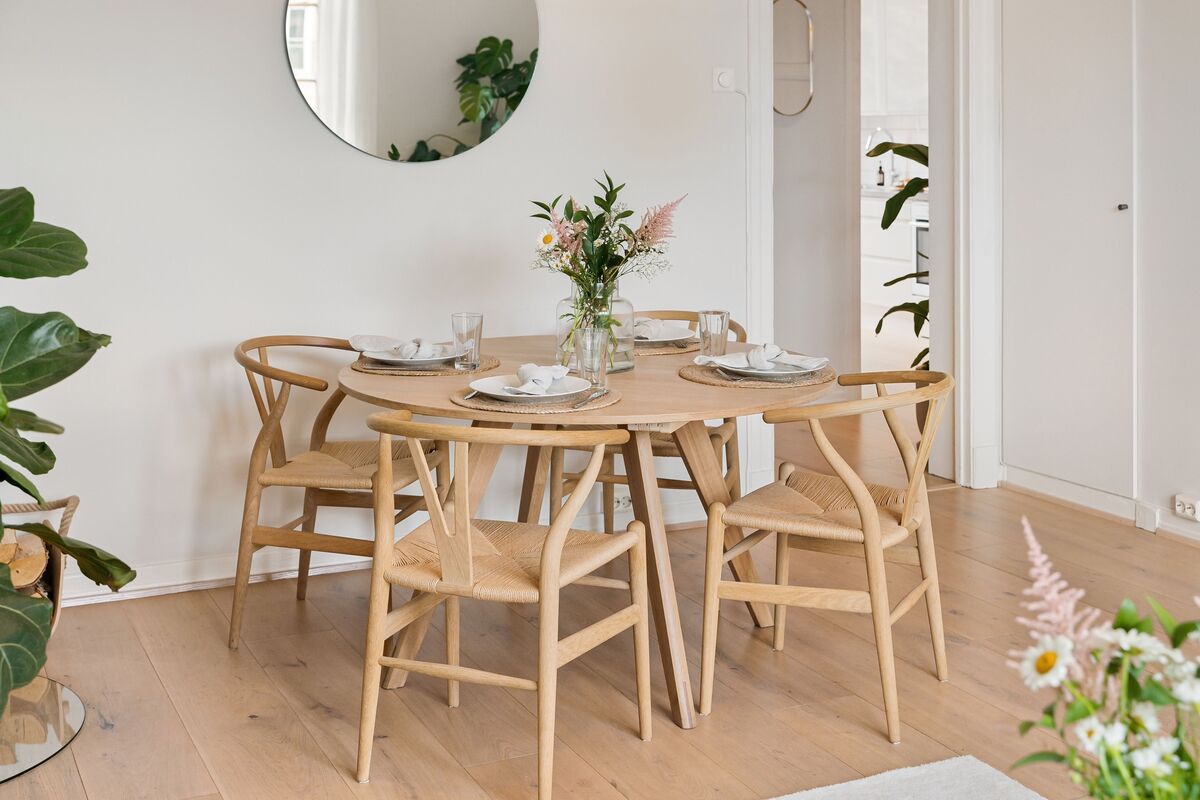
This does not require much. A cloth napkin instead of a paper one. A real glass. One thing on the surface that is beautiful and intentional — a candle you light only at meals, a small ceramic, a narrow-necked vase with a single stem. The table that looks thought-about feels different to sit at. It asks something of you — a small ceremony of arrival. The act of setting even one place intentionally is not housekeeping. It is a signal to yourself that this meal, however ordinary, is worth the dignity of your full attention.
And it extends to the quality of what you bring to the table. The food on the plate, the time allowed for eating it, the absence of the low-grade hum of something else demanding to be addressed. A designed space, in the Apartment Therapy sense, is not a decorated space — it is a considered one. The consideration you bring to your dining table is part of the design.
Making It Easy — a Ritual, Not a Rule
The phone does not go face-down on the table. Face-down is still there. It still buzzes. You still know it exists and are still quietly managing the awareness of it. Research at the University of Texas at Austin found that even the visible presence of a smartphone reduces available cognitive capacity — your brain is using resources to not check it. The discipline of ignoring it is still a form of attention paid to it.
The phone goes in another room. Or in a bag, at the far end of a counter, anywhere that requires a deliberate physical movement to retrieve it. The friction of having to stand up and walk somewhere turns out to be enough. The impulse to check typically passes within twenty seconds if you don't act on it immediately. Most of what feels urgent at the table is not, in fact, urgent — and the meal, which is entirely time-limited, actually is.
The 20-minute window is the thing worth holding onto. The average meal, eaten without rushing, takes fifteen to twenty-five minutes. That is the entire ask — not an hour of unstructured quiet, not a policy, not a lifestyle statement. Twenty minutes in which you have no obligation to be available, informed, or entertaining. Twenty minutes that belong, entirely, to the meal.
What fills the space instead is the more interesting question. Music that plays from another room creates atmosphere without consuming attention — enough texture to feel like presence, but not so directive that you track it rather than the food. A candle changes the quality of light and the mood of the space for almost no cost. A book placed nearby but not opened is an option, not an occupation. If the quiet itself feels strange at first, that strangeness is worth paying attention to. It passes faster than expected, and what it leaves behind is often more interesting than whatever you would have been scrolling.

What Starts to Change
The first thing most people notice is that they taste their food again. Not as a metaphor — literally. Flavor perception is closely tied to attention. When you eat and watch or read simultaneously, a portion of your sensory processing is allocated elsewhere, and the food becomes background information. Return your attention to the plate, and the same ingredients you have made a hundred times become, slightly, new.
The second thing is the light. You start to notice what the light looks like in your space at that particular hour — the way it moves across the table in the late afternoon, or the particular warmth of the lamp at seven in the evening. These are things you have seen every day and never quite seen. They are part of the texture of the home you have made, and they are available to you only when you are not looking at a screen.
The third — and this one takes a little longer — is that mealtimes begin to function as genuine transitions. The meal becomes a clean break between the morning and the afternoon, or between work and the evening, or between one version of yourself and the next. There is something clarifying about an activity with a clear beginning and end that asks nothing of you except your presence. The day organizes itself, slightly, around these small ceremonies. You move through it with more definition.
For meals with other people, the change is even more noticeable. Without screens, conversations go somewhere. Not always somewhere important — sometimes it is the kind of rambling, unhurried talk that doesn't produce anything and doesn't need to. But it is contact. Real contact, with another person who is also, for once, entirely there. That quality of presence is increasingly rare, and the table — the actual table, cleared and set and given the attention it was designed for — is still one of the most natural places to find it.
Twenty minutes. That is the entire ask.
Not a lifestyle overhaul. Not a radical statement. Just the phone in another room and your full attention on the meal in front of you — on the food, the light, the person across from you, or simply on yourself, which turns out to be more than enough company.