Here's the thing nobody tells you in the hair care aisle: your scalp is skin. Not metaphorically, not approximately — it is a direct anatomical extension of the skin on your face, with all the same biological complexity. It has a living microbiome. It has blood vessels and sweat glands and a natural lipid barrier. It sheds dead cells and produces oil and responds to hormones and stress. And yet most of us treat it as nothing more than the place where shampoo goes.
The result is hair that we struggle with for years — shedding that seems excessive, growth that stalls, a scalp that's either too oily or too tight and flaky — without ever addressing the actual environment. Healthy hair requires healthy soil. And the soil has been quietly neglected.
Why Scalp Skinification Is the Real Shift
The term "skinification of hair" has been circulating in beauty circles for a few years now, and I'll be honest — when I first heard it, it sounded like marketing. But the more I read into it, the more I understood it was describing something genuinely useful: applying the logic of skincare to the scalp.
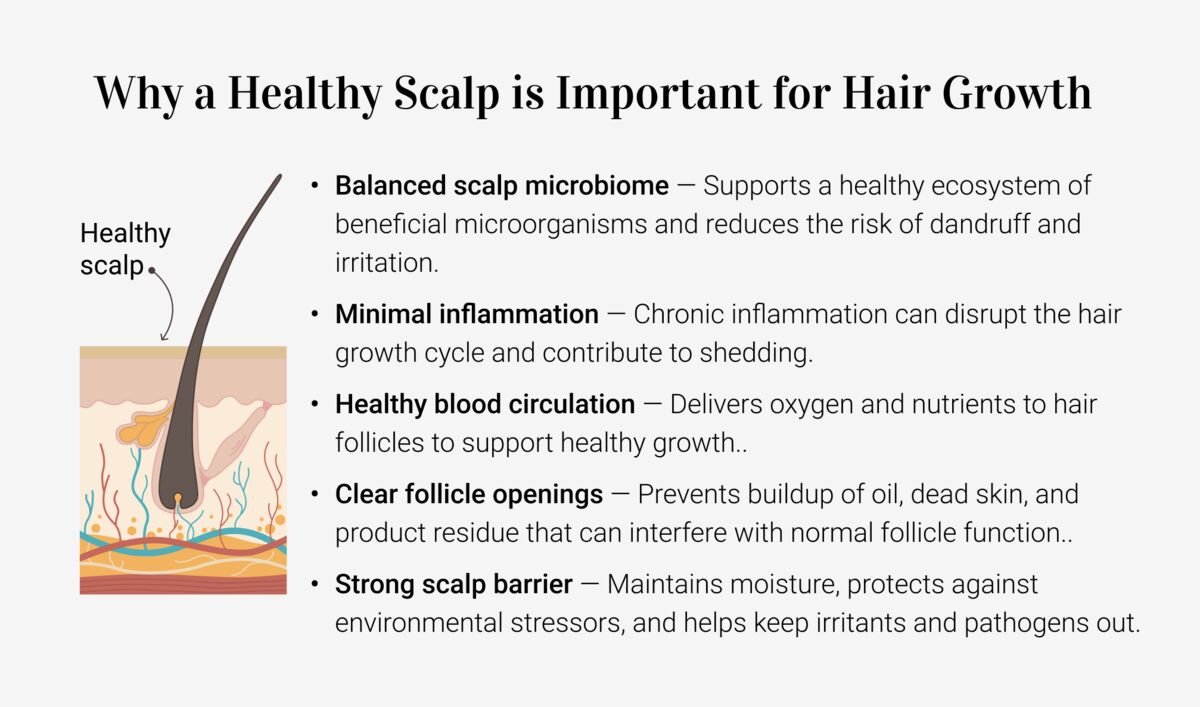
Just like the skin on your face, your scalp continuously sheds dead skin cells and produces sebum. When that process runs smoothly, hair grows in a clean, well-nourished follicle. When it's disrupted — by infrequent washing, product buildup, hormonal shifts, or an imbalanced microbiome — the follicle becomes congested. And a congested follicle cannot produce strong, healthy hair. It can barely produce adequate hair.
Thinking of your scalp as an extension of your skincare routine doesn't mean buying a dozen new products. It means bringing the same intentionality to what's happening at your roots as you already bring to what's happening on your face.
The scalp has approximately 100,000 hair follicles, each surrounded by sebaceous glands, blood vessels, and a microbiome community unique to that area of skin. Research published in the Journal of Investigative Dermatology found that scalp microbiome diversity is directly correlated with hair density and follicle health — meaning the bacterial balance on your scalp affects how much hair you actually grow.
Dandruff vs. Dry Scalp: The Confusion, Finally Cleared Up
This is the most searched question in scalp care, and for good reason — the two conditions look similar on the surface but have completely opposite causes, which means treating one with the other's remedy actively makes things worse.
- Caused by lack of moisture — the scalp isn't producing or retaining enough oil
- Flakes are small, white, and powdery; fall freely when touched
- Often accompanied by tightness, itching, and sensitivity
- Worsened by cold weather, harsh shampoos, over-washing, or low humidity
- Treat with: gentle, hydrating shampoos; less frequent washing; scalp oils
- Caused by excess oil and an overgrowth of a yeast called Malassezia
- Flakes are larger, yellowish or greasy, and tend to cling to the scalp and hair
- Often accompanied by redness, oiliness at the roots, and persistent itch
- Worsened by infrequent washing, stress, humidity, and hormonal fluctuations
- Treat with: antifungal or medicated shampoos; zinc pyrithione; salicylic acid
The key tell: dry scalp flakes fall off the moment you touch your hair. Dandruff flakes are oilier, heavier, and tend to stay put. If you're moisturising a dandruff scalp, you're feeding the yeast. If you're using antifungal treatments on a dry scalp, you're stripping what little moisture it has left. Getting this distinction right is the first, most important step in any scalp care routine.
"Your scalp isn't just the place where your hair starts. It's the environment your hair grows in — and no amount of conditioning the lengths will compensate for neglecting the roots."
The Five Golden Rules of Scalp Care
These aren't trends. They're the principles that consistently appear across dermatology research and that I've come back to again and again as the foundation of a scalp routine that actually works.
The Scalp Microbiome: What's Actually Living Up There
The scalp microbiome is one of the more fascinating recent areas of hair research, and it's gaining attention for the same reason the gut microbiome did a decade ago: it turns out that the bacterial and fungal communities living on the scalp have a direct, measurable impact on its health.
A balanced scalp microbiome keeps the skin barrier intact, regulates sebum production, and outcompetes the kind of overgrowth — particularly of Malassezia yeast — that drives dandruff and irritation. An imbalanced one, caused by overuse of harsh surfactants, antibiotic exposure, or simply the wrong products for your scalp type, can tip the ecosystem toward inflammation, excess oil, and accelerated shedding.
Practically, this means: harsh shampoos strip the microbiome along with the sebum, which is why people who use very aggressive cleansers often end up with a scalp that overproduces oil in compensation. Gentler washing, adequate frequency (under-washing allows sebum to oxidise and creates a feeding ground for yeast), and targeted exfoliating ingredients — particularly salicylic acid and glycolic acid — help maintain the balance without disrupting it.
The One Thing Worth Mentioning Every Time
I keep coming back to the sun protection fact because it genuinely changes how I think about scalp care. Skin cancer on the scalp is not rare — it accounts for a disproportionately high percentage of cases precisely because the scalp receives constant sun exposure with almost no protection. The part in your hair? An exposed line of skin that faces the sky every time you step outside. For years.
Dermatologists recommend three things: rotate your part regularly so the same strip of skin isn't always exposed; wear a hat with UPF protection on sun-heavy days; and for high-exposure situations, use a scalp-specific SPF product — sprays work well because they don't leave residue in the hair. It sounds like a small addition. Over years, it's anything but.
According to the Skin Cancer Foundation, approximately 13% of cutaneous squamous cell carcinomas — one of the most common forms of skin cancer — occur on the scalp or neck. Because the scalp is difficult to self-examine and often obscured by hair, these cancers are frequently diagnosed later than those in more visible locations. Annual skin checks with a dermatologist who examines the scalp are worth building into your routine.
Your hair starts somewhere.
Everything you're doing at the lengths — the masks, the oils, the trims — matters. But healthy hair is built from the root up. Treating your scalp with the same care and curiosity you bring to your skin doesn't require a complete routine overhaul. It requires a shift in how you think about where hair care actually begins. Start there, and the rest follows.